

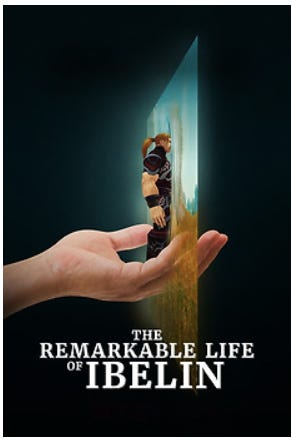
The click of the keyboard
I recall a family case where I had to insist that they let the child continue to play the multiplayer online game Fortnite throughout our therapeutic sessions. I remember fostering conversations with the young man alongside the sound of the typing of his keyboard. At the time, I wasn’t entirely sure I was correct, but it felt intuitive to let him inhabit the world that seemed highly regulating and social for him. It was as if I had to weave myself into his world, all the while maintaining an attitude of wonderment around how he connected and made sense of his universe.
When I watched The Remarkable Life of Ibelin, I recognised something of that instinct—to trust that the virtual landscape could possess an attachment dimensionality that was not immediately apparent from outside. Tears streamed down my face. I felt such incredible compassion for the oft misunderstood social power it affords, especially for generations who have grown up leveraging its newfound capacities for social contact.
Worlds within worlds
The film chronicles the online world of a disabled young man in Norway who, because of a degenerative muscular disease, became increasingly limited in his movements. A custom-built computer interface gave him the capacity to continue participating in an online world. While his parents feared that he was living an increasingly isolated life, there was much they could not see. After his death at the age of 25, a hidden world (to them) was revealed to the family, and the creators of the film decided to reanimate, both literally and figuratively, his life; it wasn’t just that he had an existence online, but had thrived, loved, lost, and helped others heal.
The film’s power, beyond the remarkably touching story of this man’s life, is its challenge to superficial appraisals of both the shifts in how advanced technologies have become a part of our everyday experience and the quality of relationship that can be fostered and inhabited in virtual environments.
The relationship is the relationship is the relationship
Online gaming and its technological ecosystems are often casually referred to as toxic and antisocial, and typically employed in arguments for a return to ‘real’ relationship or eros in our professional jargon. Such appraisals can obscure more than they reveal. One must think critically about the function of any technology and whether it is part of a pathologically defensive structure or integrated into a good enough relational whole (or somewhere in between).
Too often, particularly with an inherited tradition in psychoanalysis that values meaning making in what might be considered analogue environments (the setting of the physical office, the couch, meeting face-to-face), we dismiss constantly evolving forms of communication as a dilution of our superior ‘technologies’ and/or as contributors to dis-ease and general malaise. I have often argued for a more open-minded consideration of what is essential in relationships, and this film showcases the incredible power of technology to connect, repair, and facilitate human contact.
This does not mean that every online environment affords the same possibilities, or that concerns about children’s use of technology are misplaced. It does ask us to consider more carefully what is taking place within a particular world, and what that world means to the person inhabiting it.
Just because it’s foreign to you…
When working with children, maintaining a sense of curiosity about how technology factors into their attachment landscape (i.e., who do they lean on, how do they connect with friends, what meaning is ascribed to the worlds they have libidinally invested in?) is crucial. Ruptures can occur when caregivers are reductive and dismissive of the intricate and meaningful layers that are woven into the fabric of these technological universes.
In a sadly ironic twist, attempts to protect children from the ‘online world’ can themselves become a source of hurt when they disregard the relationships and meaning children have found there. We must find ways to connect before we redirect when it comes to our attempts to forge alliances with children, lest we simply disregard the three dimensionality of their inner worlds and, more specifically, how they have invested their attachment needs.
My concern is that in the name of ‘protecting’ the next generation, we may also play out the archetypal patterns of negating what is both anxiety provoking and foreign to us. Akin to the analyst struggling to attune to the world of a patient, metabolising myriad attacks from without and within all the while trying to return to the therapeutic position, so too is there a remarkable demand on the older generation to try and ‘think’ the value of disruptive technologies.
Ibelin’s world presents a rich metaphor for the aliveness that often exists beyond the limits of our comprehension.
You never know what you’ll find
In closing, I recall one of the responses to the then remarkable technologies Jung and his colleagues were availing themselves of, the galvanometer amongst other tools, to evaluate and measure the physiological consequences of complexes in the word association experiments. Peterson (1907), in an address to the British Medical Association, said of Jung’s methods, “It is like fishing in the sea of the unconscious, and the fish that likes the bait best jumps to the hook”.
This comment has always struck me as possessing an almost childlike excitement at the prospect of what was being discovered and the potential these new technologies possessed. Similarly, The Remarkable Life of Ibelin may change how you look at what is humanly possible in the oft maligned online world of gaming. It is a world certainly worth entering.
* * *
Peterson, F. (1907). The galvanometer as a measure of emotion. British Medical Journal, 2, 804–806.
Beautifully nuanced. The same question rises: how much gaming is needed for a whole world to evolve inside a child, and where are the parents when that evolution is happening? No 'human attachment' at least not from the old version of human to human happens when gaming, but deep attachments to the inner world, fantasy and imagination controlled by the algorithms. However your point about considering and entering into a 'gamer' child's deep love for gaming is spot on. From there?